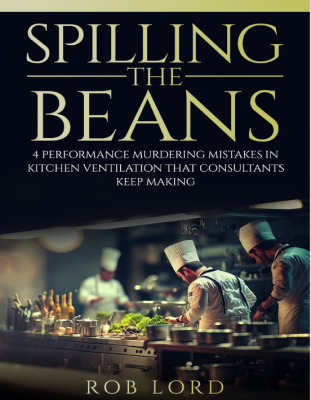
A 10% productivity gain in a four-person commercial kitchen is worth approximately $82 per hour. Over a year of service, that number compounds quickly. Yet most commercial kitchens are designed to code minimums — standards that, as SEED Engineers’ new eBook Spilling the Beans makes clear, fall well short of what’s needed to support a productive, profitable kitchen operation.
Written by Rob Lord, the eBook identifies four performance-killing mistakes that well-meaning but inexperienced kitchen ventilation consultants keep making — and explains what kitchen operators can do about them. Here’s a summary of the key insights.
The 4 comfort factors that drive kitchen productivity
Thermal comfort. When the body overheats, blood is redirected from the brain and critical organs to the skin to release heat — from 4% of blood flow under comfortable conditions to 48% under heat stress. Research suggests productivity loss can approach 30% when kitchen temperatures reach what most people would simply describe as “warm” (around 30°C). The standard temperature for performance is 23°C, yet most kitchen design targets 26°C. That 3°C gap represents a 13.5% productivity loss before service even begins.
Visual comfort. Code-compliant lighting in food preparation areas typically sits around 500 lux. Research indicates that improving to 750 lux can increase task accuracy by 10–25% and reduce eye strain by more than half, with workers reporting significantly higher job satisfaction. The difference between a code-minimum lighting spec and a productivity-optimised one is not large in cost — but the performance impact is substantial.
Acoustic comfort. A noisy kitchen increases error rates, reduces communication clarity, and raises stress. Achieving a reverberation of 0.7 seconds and a noise level of NC40 or below can improve worker productivity by up to 20%. This requires deliberate design decisions around equipment placement, HVAC noise, and sound absorption — none of which standard code compliance addresses.
Air quality. The Australian code permits outside air flow rates as low as 7.5 LPS per person. Research suggests that rates approaching 30 LPS per person — four times the code allowance — are needed to meaningfully reduce absenteeism in busy kitchen environments. Poor indoor air quality impairs cognitive function, reduces comfort and satisfaction, and increases staff turnover.
The 3 most common mistakes kitchen operators make
Designing for energy efficiency instead of staff effectiveness. Code compliance and staff productivity are not the same thing. A consultant who meets the Deemed-to-Satisfy (DTS) minimum for thermal comfort, lighting, and ventilation has technically done their job — but they may have delivered a kitchen environment that actively undermines the performance of the people working in it. The eBook makes a clear case for briefing designers against a productivity standard, not an energy standard.
Designing only for the worst case. Fans and ventilation systems sized for peak demand run at full speed — and full noise — even when the kitchen is operating at 40% capacity. The Fan Affinity Laws show that reducing fan speed by half cuts power consumption to one-eighth and noise levels by 15dBA. A demand control ventilation system (typically $8,000–$18,000 and retrofittable) adjusts fan speed in response to actual cooking activity, reducing noise, extending equipment life, and lowering energy costs — all without compromising capture.
Ignoring grease removal efficiency. A standard kitchen grease filter captures only 20–40% of the grease that enters the hood. The remainder accumulates in the ductwork, creating fire risk, odour nuisance, and significant ongoing cleaning costs. High-efficiency filtration technologies that remove upwards of 94% of grease are readily available. Installing one unlocks further benefits: acoustically-lined ductwork, reduced compliance costs, and even the possibility of partial air recirculation.
3 insider secrets to restore kitchen performance
Use the German Code of Kitchen Ventilation (VDI2052). The German ventilation standard includes ergonomic guidelines for comfort conditions, air velocities, and acoustics that the Australian code lacks. It also uses equipment power input as the basis for airflow calculations — which makes it particularly well-suited to designing with demand control ventilation in mind. It doesn’t require the same extent of hood overhang as AS1668.2, which can reduce hood size and cost. It requires the operator to have finalised equipment and menu choices before design begins, but for operators prepared to do that work upfront, the standard offers meaningful advantages.
Code can be exceeded — legally. The Building Code requires compliance with performance requirements, not compliance with the Deemed-to-Satisfy pathway. A Performance Solution (such as a JV3 energy model) allows a kitchen to exceed code minimums for lighting and cooling — delivering the thermal comfort, visual comfort, and air quality that productivity demands — by demonstrating energy savings elsewhere, such as through demand-controlled ventilation and dimming. Most DTS engineers won’t propose this approach because it requires more work. A genuine kitchen specialist will.
Kitchen hood design is more critical than most operators realise. The hood affects thermal comfort (through make-up air strategy), noise levels (through airflow and filter design), grease capture efficiency, and demand control performance. Hoods are frequently value-managed out of specifications to reduce upfront cost. The eBook makes a compelling case for treating the hood as a core investment, not a line item to trim — the downstream costs of a poorly performing hood in maintenance, noise, energy, and staff comfort far exceed the initial saving.
The bottom line
Most kitchen ventilation consultants are generalist building services engineers, not kitchen specialists. They design to the minimum required by code and consider their job done. The result is a kitchen environment that may be compliant but is not productive — and in a labour-intensive, margin-sensitive business, that gap has a measurable dollar value.
Spilling the Beans gives kitchen operators the language and the framework to demand better from their design consultants — and to understand what a genuinely productive kitchen environment looks like, sounds like, and feels like.
Download the full eBook : https://info.seedengineers.com/download-spilling-the-beans