Odour nuisance risks occur when the amount of odour (OU) produced from various kitchen processes are not adequately or efficiently ventilated through the kitchen exhaust design. Some odours – such as baking bread – can be considered pleasant at higher concentrations, while high grease odours – such as deep-fried food – can be unpleasant in low concentration. One odour unit (OU) is a defined as the level of odour concentration, where 50% of the public can detect there is an odour without necessarily being able to describe it.
The guidelines provided to us from the Queensland EPA states that if they have received an odour complaint about a kitchen that produces 10 OU they will consider prosecuting the owner. In such scenarios, the Queensland EPA will acknowledge there is an odour nuisance and will request the owner to reduce the odour exhausted to <5 OU. For reference, a typical burger kitchen exhaust system can be in the range of >700 OU without treatment. Here at SEED, we use dispersion modelling and a range of on-site measurement techniques (compliant to AS 4323.3:2001) to determine what circumstances an odour complaint may be justified.
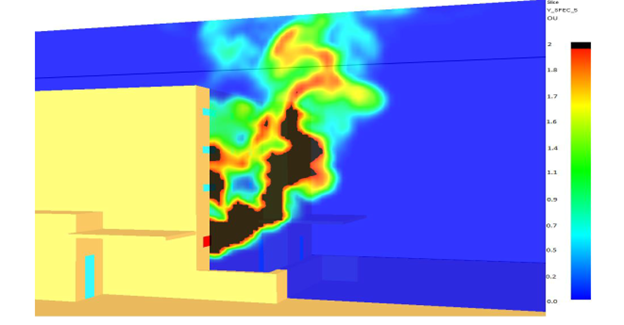
An isosurface showing the odour reading at the exhaust vent rising up the western side of the building. 2 OU approximately corresponds to the black colour.
Additionally, due to building and tenant restrictions, the exhaust may be unable to be discharged in the position or manner dictated by the Australian Standards. SEED is able to achieve compliance via an engineered discharge and performance approaches that use effective exhaust cleaning techniques to minimise odour nuisance risk.
Delivering a successful development project is rarely about finding one revolutionary idea. More often, the biggest improvements come from making the right decisions at the right time.
Read MoreSome engineers are drawn to the profession by a single defining moment. For Mustafa, it was something more cumulative, a lifelong curiosity about the world being built around him, and a growing fascination with the systems that make it all work. In this edition of A Day in the Life of an Engineer at SEED Engineers, we introduce Mustafa, our Senior Electrical Engineer, whose 14 years of experience across Australia and the world bring a rare depth of perspective to every project he touches.
Read MorePrefabrication is transforming the construction industry — offering speed, cost-efficiency, recycling opportunities and quality control by shifting building work from site to factory. This process has the potential to be superior to traditional building in terms of both time and costs, with claimed time savings of between 20 and 50 percent faster than traditional building techniques.
Read MoreOur sustainability team blends practical construction experience with deep knowledge of sustainable design and performance standards. You’ll work directly with specialists who understand the realities of real-world projects and can deliver strategies that are both environmentally responsible and commercially practical.
Mechanical & Sustainability Engineer (3+ years experience)
Project Manager
Marketing
Talk to us about your project. We focus on acutely understanding your needs and finding solutions that integrate seamlessly with your design and construction goals. Our team will collaborate closely with you every step of the way, offering insight and practical know-how to ensure your project’s unique sustainability needs are efficient, compliant, and well-coordinated.
Many odour problems occur because the ventilation system is treating the symptom rather than the source. Sewer gases, waste rooms, commercial kitchens and industrial processes all produce different pollutants that require different engineering solutions. At SEED, we combine airflow modelling, pollutant analysis and practical engineering to identify the true cause before recommending a solution. This approach often resolves problems that conventional ventilation upgrades cannot.
Often, yes. Many odour issues can be resolved by improving airflow paths, balancing pressures, upgrading controls or introducing targeted filtration rather than replacing entire systems. Because SEED designs mechanical, hydraulic and specialist odour control systems together, we can often identify practical, cost-effective solutions that minimise disruption while delivering measurable improvements.
Odour control sits at the intersection of several technical disciplines. Most other consultants will emphasise ho wtheyare specialists in one of those disciplines. Rather than relying on one type of solution, or standard ventilation rules, SEED applies computational modelling, field investigations and decades of experience across mechanical, hydraulic and environmental engineering disciplines. We aim to solve complex problems that others have struggled to resolve, providing practical solutions backed by engineering evidence.